Clearblue Ovulation Test
Introduction
Are you trying to conceive and feeling overwhelmed by cycle tracking? You’re not alone—studies show that up to 80% of couples face challenges pinpointing ovulation, the key window for pregnancy.
Enter the Clearblue ovulation test: a reliable, at-home tool that detects your luteinizing hormone (LH) surge with over 99% accuracy.
In this comprehensive guide, we’ll break down everything from Clearblue ovulation test instructions to interpreting results, troubleshooting resets, and comparing strips versus digital options. Whether you’re new to fertility tracking or refining your routine, you’ll walk away empowered to maximize your chances.
What Is the Clearblue Ovulation Test?
The Clearblue ovulation test is a popular over-the-counter kit designed to help women identify their fertile window—the two to five days each cycle when conception is most likely. Unlike basal body temperature tracking or cervical mucus observation, this test focuses on the LH surge, a hormonal spike that triggers ovulation within 24 to 36 hours.
Clearblue offers several variants to suit different needs and budgets:
- Analog Strips: Simple, affordable dipsticks for visual line comparison.
- Digital Test: Features a reader for clear smiley-face results, reducing guesswork.
- Advanced Digital: Tracks both LH and estrogen for a broader fertile window (up to four days).
- Connected System: App-integrated for seamless cycle logging.
These tests are FSA-eligible in many regions and backed by decades of research from Clearblue, a leader in pregnancy and fertility diagnostics. By using one, you can time intercourse strategically, potentially increasing pregnancy odds by 20-30% per cycle, according to fertility experts.
How Does the Clearblue Ovulation Test Work?
At its core, the Clearblue ovulation test measures LH levels in your urine. LH, produced by the pituitary gland, surges dramatically (up to 10 times baseline) right before ovulation, releasing an egg from the ovary.
The Science Behind LH Detection
Ovulation typically occurs mid-cycle, but irregular periods can make it tricky to predict. The test’s absorbent tip captures urine and reacts with antibodies to LH, producing a visible line or digital signal if levels hit the threshold (usually 25-30 mIU/mL). This mirrors lab blood tests but in a user-friendly format.
Research from the American College of Obstetricians and Gynecologists (ACOG) confirms LH-based tests like Clearblue are highly effective for most women, though factors like PCOS can affect results.
Clearblue Ovulation Test Instructions: Step-by-Step Guide
Getting started is straightforward, but following the protocol ensures accuracy. Always test with first morning urine for concentrated LH levels—avoid testing after heavy fluid intake.
How to Use Clearblue Ovulation Test Strips
Clearblue ovulation test strips are budget-friendly and ideal for beginners. Here’s how:
- Determine Your Start Day: Calculate based on cycle length (days from period start to next). Start 17 days before your expected period. For a 28-day cycle, begin on day 11.
- Prepare: Wash hands and collect urine in a clean cup if not testing in-stream.
- Test: Hold the absorbent tip in your urine stream for 5-7 seconds or dip in a sample for 15 seconds. Keep the tip down—never upright.
- Wait: Lay flat for 3-10 minutes. Avoid peeking early.
- Read: Compare the test line to the control line (see results section below).
Test daily until positive, then stop—ovulation follows soon after. Pro tip: Track in an app like our fertility calendar tool for reminders.
Digital Clearblue Ovulation Test Instructions
For no-fuss results, opt for the digital version:
- Insert Stick: Snap a new test stick into the reusable holder.
- Test: Midstream for 3 seconds or dip for 15 seconds.
- Wait: The display shows a progress bar; results appear in 3 minutes.
- Eject and Store: Remove the stick—the holder resets for next use.
The Advanced Digital adds estrogen tracking for “high” fertility alerts before the peak.
Interpreting Clearblue Ovulation Test Results
Results are your roadmap to the fertile window. Misreading them is a common pitfall—let’s clarify.
Positive, Negative, and Invalid Results Explained
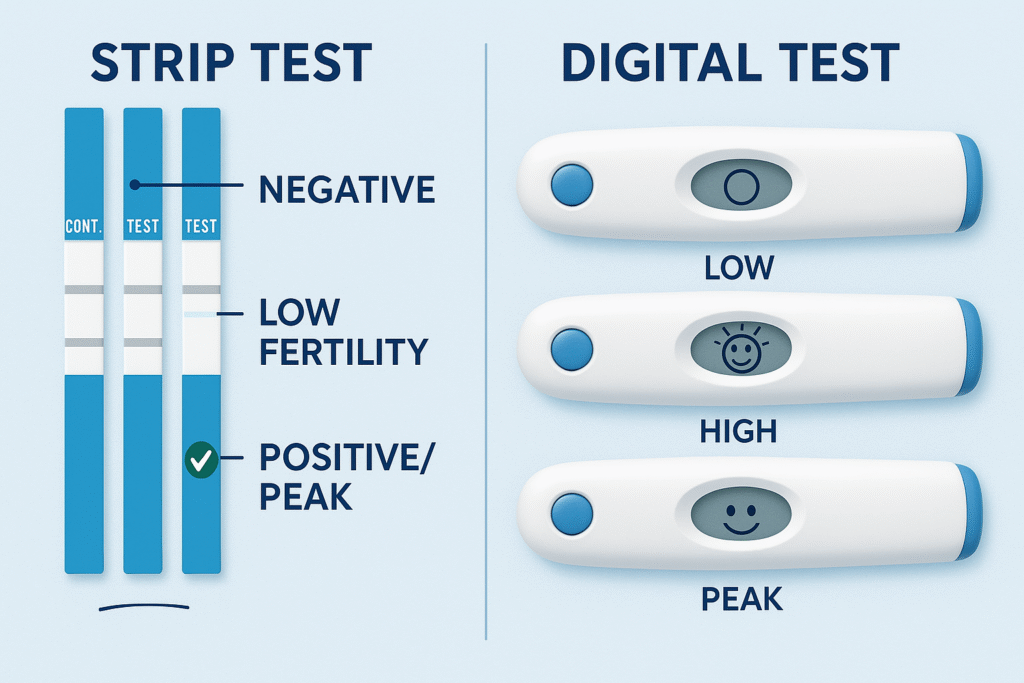
- For Strips:
- Negative: Test line lighter than control—LH low, keep testing.
- Positive: Test line as dark or darker than control—LH surge detected; ovulate in 24-36 hours. Have intercourse that day and next.
- Invalid: No control line or faint—retest with a new strip.
- For Digital:
- Low Fertility (Blank Circle): No surge yet.
- High Fertility (Flashing Smiley): Rising estrogen; good time to try.
- Peak Fertility (Solid Smiley): LH surge; prime conception days. Stays lit for 48 hours.
- Invalid: Error symbol—check battery or retest.
A 2024 WebMD review notes that positive results align with ultrasound-confirmed ovulation 97% of the time. If no positive after expected days, consult a doctor—could signal anovulation.
How to Reset the Clearblue Digital Ovulation Test
Frustrated by a stuck display? The digital holder doesn’t have a manual reset button to avoid errors, but here’s what works:
- After Peak: The solid smiley auto-resets after 48 hours, or by the next cycle start. Don’t force it—removing batteries voids the warranty and breaks functionality.
- Cycle Reset: Input your period start in the app (for Connected model) to recalibrate.
- Troubleshooting: If frozen, wait 24 hours or replace batteries (CR 2032). For persistent issues, contact Clearblue support.
Users on forums report success by simply powering off/on, but always follow official guidance to maintain accuracy.
Tips for Accurate Results with the Clearblue Ovulation Test
Maximize reliability with these evidence-based strategies:
- Timing is Key: Test between 10 AM and 8 PM, same time daily. First morning urine is best for strips.
- Hydration Balance: Drink normally, but skip excess water 2 hours before—dilutes LH.
- Storage: Keep kits at 36-86°F; avoid bathrooms with humidity.
- Cycle Awareness: Irregular cycles? Use the Advanced model for broader detection. Combine with BBT for confirmation.
- Avoid Errors: Don’t test twice daily—it can trigger false highs.
A study in Fertility and Sterility found consistent testing routines boost detection rates by 15%. For more, explore our top ovulation tracking apps review.
- Lifestyle Boosts: Maintain a healthy BMI (18.5-24.9), as extremes affect ovulation per CDC guidelines.
- Partner Sync: Share results to align efforts—communication doubles success stories.
Clearblue Ovulation Test Strips vs. Digital: Which to Choose?
| Feature | Strips | Digital/Advanced |
| Cost | $20-30 for 20-pack | $30-50 for 10-20 tests |
| Ease of Use | Visual comparison (subjective) | Smiley icons (objective) |
| Fertile Days Detected | 2 peak days | Up to 4 (with estrogen) |
| Best For | Budget-conscious beginners | Tech-savvy users wanting precision |
| Accuracy | 99% LH detection | 99%+ with digital reader |
Strips suit simple tracking; digital shines for clarity. If undecided, start with strips and upgrade—many do for the peace of mind.
Common Questions About the Clearblue Ovulation Test
Tackling your top searches:
- How soon after a positive can I ovulate? 24-36 hours—plan BD (baby dance) ASAP.
- What if I never get a positive? Test longer or see a specialist; 10-15% of cycles are anovulatory.
- Can I use during breastfeeding? Yes, but LH may vary—monitor closely.
- Expiration Impact? Use by date; expired tests lose sensitivity.
- Pregnancy Test Crossover? Positives don’t confirm pregnancy—follow with a Clearblue pregnancy test 10-14 days post-ovulation.
Conclusion
The Clearblue ovulation test stands out as a trusted, science-backed ally in your fertility journey, transforming the often confusing process of cycle tracking into a clear, actionable plan.
With straightforward Clearblue ovulation test instructions, easy-to-interpret results—whether you’re reading lines on strips or smiley faces on a digital screen—and hassle-free reset options for the holder, this tool empowers you to pinpoint your LH surge with over 99% accuracy.
Whether you choose budget-friendly Clearblue ovulation test strips for daily monitoring or the Advanced Digital model to capture up to four high-fertility days through estrogen tracking, you’re equipped to time intercourse precisely during your most fertile window, potentially boosting conception chances by 20-30% each cycle.
Success with the Clearblue ovulation test hinges on consistency: testing at the same time daily, starting on the right cycle day, and combining results with lifestyle factors like balanced hydration, proper storage, and a healthy BMI (18.5-24.9, as recommended by CDC guidelines).
For those with irregular cycles, PCOS, or breastfeeding, the test remains adaptable—though consulting a healthcare provider for personalized advice ensures the best outcomes. Real users report fewer missed opportunities and reduced stress, with many conceiving within 1-3 cycles of diligent use.
About the Author